Cambridge Body Memory Test
This pre-configured paradigm lets you collect data using the Cambridge Body Memory Test - a variant of the Cambridge Face Memory Test (CFMT) that uses body images (headless figures) as stimuli instead of faces. With this "preset", you can quickly assess body recognition abilities and determine whether face recognition deficits are specific to faces or extend to other human-related visual categories. This page explains how to use the preset, what data you'll collect, and how to analyze your results.
Research using this test helps distinguish between face-specific processing deficits and broader difficulties with processing configural or person-related information.
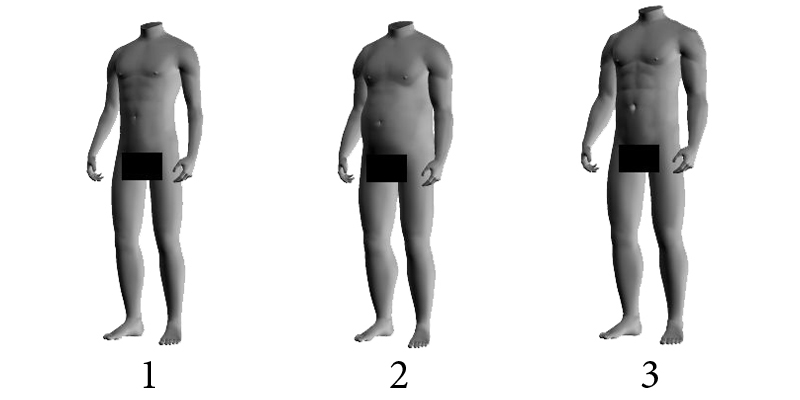
Example stimulus from the Cambridge Body Memory Test showing bodies that participants must learn to recognize and discriminate.
Quick Start
- Create or open an experiment from your Dashboard
- Click Add pre-configured tasks
- Choose "Cambridge Body Memory Test"
- Preview your experiment
New to Meadows? See the Getting Started guide for a complete walkthrough.
Background
The Cambridge Body Memory Test was developed by Susilo and colleagues as part of a battery of tests to evaluate visual recognition abilities across different stimulus categories12. Bodies, like faces, are important social stimuli that require processing of configural information and subtle differences between similar exemplars. By following the identical structure and procedure as the CFMT, the test ensures that any performance differences between faces and bodies can be attributed to category-specific processing rather than task demands.
Research has shown that body recognition involves both overlapping and distinct neural mechanisms compared to face recognition1. Some individuals with prosopagnosia show preserved body recognition abilities, suggesting face-specific deficits, while others show impairments across multiple categories.
Test Structure
The preset includes a single task (cmt_bodies) that follows the standard Cambridge Memory Test format. Participants typically complete the test in 10-15 minutes.
- Practice Phase - Familiarization with the task
- Introduction Phase - Learn target body identities (shown from 3 viewpoints each)
- Review Phase - Review all target bodies
- Novel Test - Identify targets among novel distractor bodies
- Noise Test - Identify targets with visual noise added (more difficult)
In each test trial, participants view 3 bodies and press 1, 2, or 3 to indicate which body is one of the target identities.
Tasks Included
This preset contains the following task:
| Task Name | Task Type | Description |
|---|---|---|
cmt_bodies |
cmt |
The body memory test with all phases |
Data
For general information about the various structures and file formats that you can download for your data see Downloads.
As stimulus-wise "annotations" (table rows), with columns:
trial- numerical index of the trialtime_trial_start- timestamp when the test images were displayed (seconds since 1/1/1970)time_trial_response- timestamp when the participant responded (seconds since 1/1/1970)stim1_id- Meadows internal id of the stimulusstim1_name- filename encoding trial informationlabel- the key pressed by the participant (1, 2, or 3)
Analysis
Scoring
The primary outcome is the total score (number of correct responses). Score calculation is identical to the CFMT.
In Google Sheets or Microsoft Excel, you can score the test:
-
Load Data: Download the annotations data in Table format from Meadows, then import the
Meadows_myExperiment_v1_cmt_bodies1_annotations.csvfile into your spreadsheet application. -
Create Correct Column: Add a formula to check if the response was correct. In a new column (e.g., column D if
This assumes the correct answer is always "1" (the target in the first position). Drag this formula down for all rows.labelis in column C): -
Calculate Total Score: Sum the correct responses:
-
Calculate Percentage: Divide by the total number of trials:
-
Calculate Reaction Time: Create a formula to calculate RT in milliseconds:
Then calculate the mean RT across all trials.
import pandas as pd

# Load the annotations data
df = pd.read_csv('Meadows_myExperiment_v1_cmt_bodies1_annotations.csv')

# For standard CMT, the target is typically in position 1
df['correct'] = df['label'] == '1'

# Calculate total score
total_score = df['correct'].sum()
max_score = len(df)
percentage = (total_score / max_score) * 100

print(f"Total Score: {total_score}/{max_score} ({percentage:.1f}%)")

# Calculate reaction time
df['rt_ms'] = (df['time_trial_response'] - df['time_trial_start']) * 1000
print(f"Mean RT: {df['rt_ms'].mean():.0f} ms")
library(tidyverse)

# Load the annotations data
df <- read_csv('Meadows_myExperiment_v1_cmt_bodies1_annotations.csv')

# Calculate accuracy
df <- df %>%
  mutate(
    correct = label == '1',
    rt_ms = (time_trial_response - time_trial_start) * 1000
  )

# Calculate total score
results <- df %>%
  summarise(
    total_score = sum(correct),
    max_score = n(),
    percentage = mean(correct) * 100,
    mean_rt = mean(rt_ms)
  )

print(results)
Interpreting Scores
Performance on the Cambridge Body Memory Test is typically compared with performance on the CFMT to assess the specificity of recognition deficits. Key patterns include:
- Face-specific deficit: Normal body recognition but impaired face recognition
- Domain-general deficit: Impaired performance on both face and body tests
- Dissociation: Different patterns of performance suggesting distinct processing mechanisms
Individual Differences
Performance on body recognition can vary across individuals. When comparing with face recognition, consider that some people may show category-specific processing differences.
References
-
Susilo, T., Yovel, G., Barton, J. J. S., & Duchaine, B. (2013). Face perception is category-specific: Evidence from normal body perception in acquired prosopagnosia. Cognition, 129(1), 88–94. doi:10.1016/j.cognition.2013.06.004 ↩↩
-
Susilo, T., Wright, V., Tree, J. J., & Duchaine, B. (2015). Acquired prosopagnosia without word recognition deficits. Cognitive Neuropsychology, 32(6), 321–339. doi:10.1080/02643294.2015.1081882 ↩