2048 Puzzle Game
The 2048 puzzle game is a single-player sliding tile puzzle where participants combine numbered tiles to reach higher values. This task provides an engaging activity for filler periods, attention breaks, or participant engagement between experimental tasks. While the game itself doesn't collect response data, it offers a motivating, low-cognitive-load activity that keeps participants engaged.
2048 is played on a 4×4 grid. Every turn, a new tile (2 or 4) appears randomly in an empty spot. Participants use arrow keys to slide all tiles in one direction; when two tiles of the same number collide, they merge into their sum. The game continues until no moves remain or time expires.
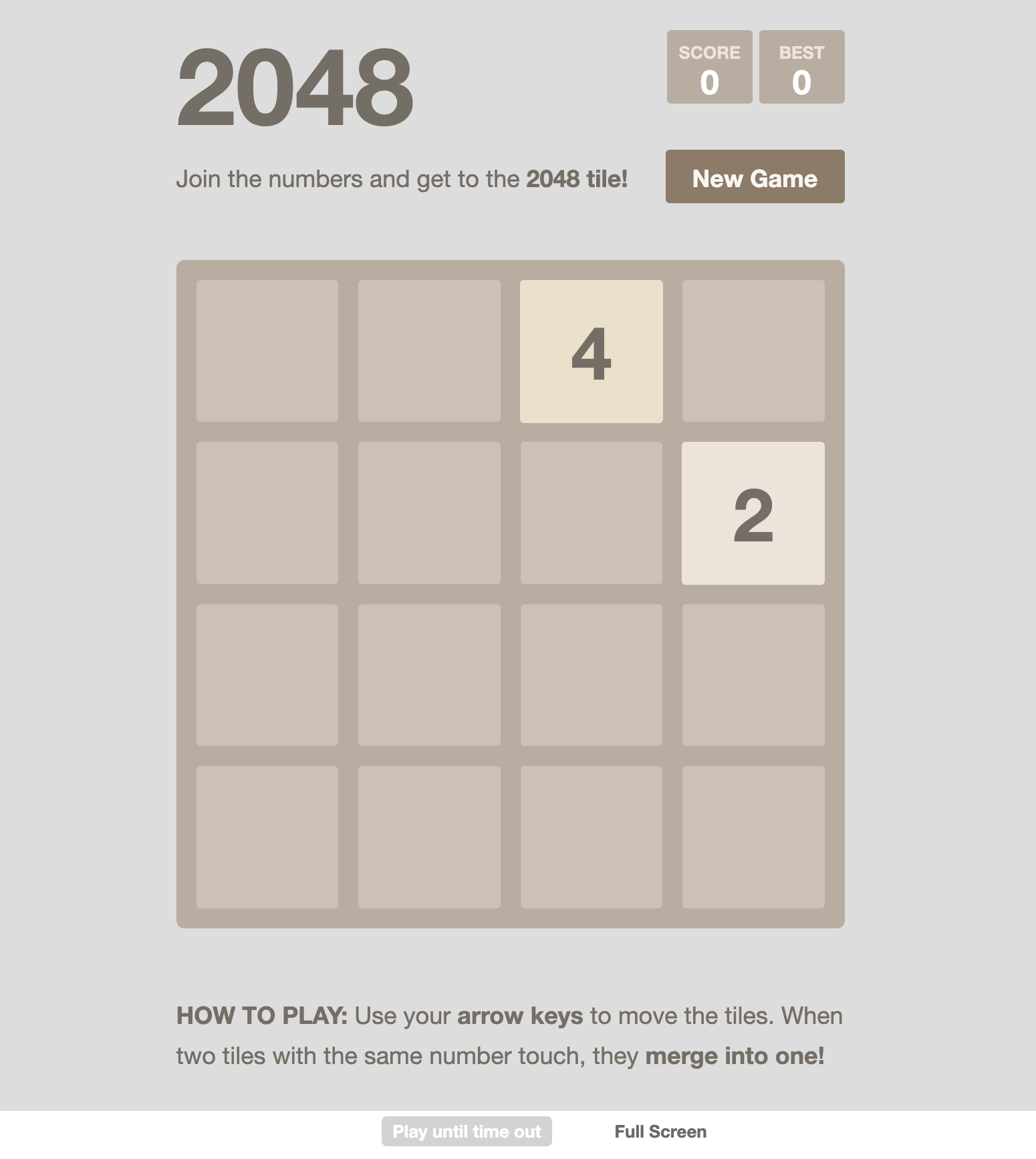
The 2048 puzzle game interface showing the 4×4 grid with numbered tiles.
Quick Start
- Create or open an experiment from your Dashboard
- Click Add task and select "Puzzle 2048"
- Set the game duration (how long participants can play)
- Preview your experiment
New to Meadows? See the Getting Started guide for a complete walkthrough.
Use Cases
The 2048 game is primarily useful for:
- Filler tasks: Provide engaging activity between experimental blocks
- Rest breaks: Give participants a mental break while keeping them engaged
- Gamification: Add an element of fun to longer experiment sessions
- Warm-up: Help participants become comfortable with keyboard responses
Alternative tasks
- Use an Information task for displaying text instructions or breaks without interaction.
- Use a Slideshow task for presenting stimuli during rest periods.
Parameters
Customize the task by changing these on the Parameters tab of the task.
Game Settings
Duration-
How long participants can play the game, in minutes. After this time elapses, the task automatically completes. Default: 5 minutes. Valid range: 0 to 240 minutes.
Wait Button Label-
The label shown on the toolbar button while the game is in progress. Participants cannot advance until the duration expires. Default: "Play until time out". Maximum: 20 characters.
How to Play
The game uses keyboard controls:
| Key | Action |
|---|---|
| Arrow Up | Slide all tiles up |
| Arrow Down | Slide all tiles down |
| Arrow Left | Slide all tiles left |
| Arrow Right | Slide all tiles right |
Game mechanics:
- Tiles slide as far as possible in the chosen direction
- When two tiles of the same number collide, they merge into one tile with their combined value
- A new tile (2 or 4) appears after each move
- The score increases by the value of each merged tile
- The traditional goal is to create a 2048 tile, but play continues until time expires
Data
This task does not collect behavioral response data. It is designed as a utility task for engagement purposes rather than as an experimental measure.
For experiments requiring timed responses or game-like interactions with data collection, consider using the Timed Key Response task.
About 2048
2048 was created in 2014 by Gabriele Cirulli as a web-based puzzle game. It quickly became popular due to its simple rules and addictive gameplay. The game is inspired by earlier sliding puzzle games including Threes! by Asher Vollmer.
For more information about the game mechanics and history, see the Wikipedia entry on 2048.